Skip to content


Updated on
Both agents start at $20 a month: Claude Pro or ChatGPT Plus. See every plan
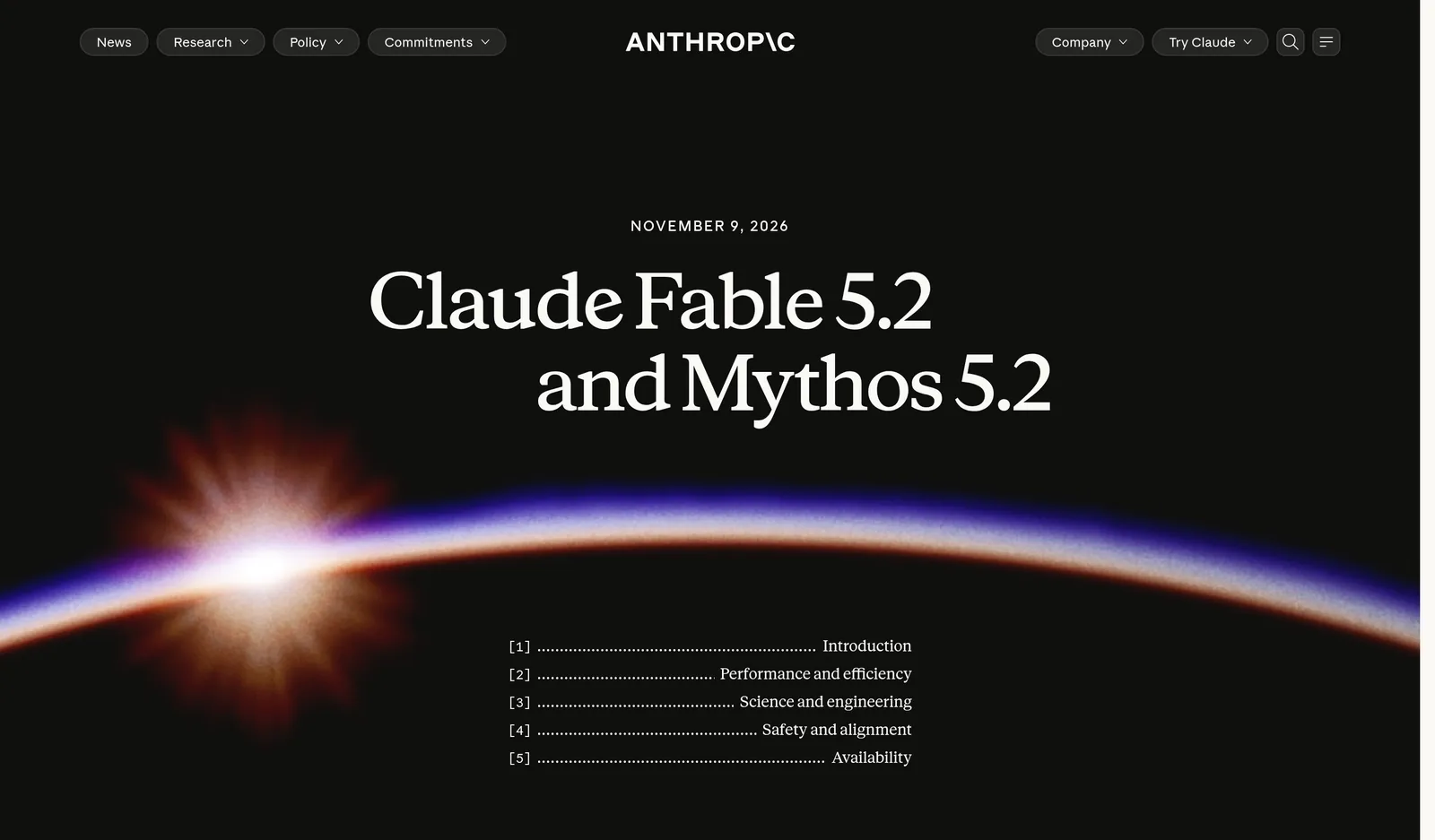
Hey, what’s up, party people! So Claude Code vs Codex just got a lot more interesting. In the last three weeks Anthropic shipped Claude Fable 5.2 and a new ship command for Claude Code, and OpenAI put GPT-6.2 Astra and Sol into Codex. Both agents still start at $20 a month.
Here’s the short answer. If you build in GitHub and want an agent that walks your pull requests through review, Claude Code got the bigger upgrade. If you already pay for ChatGPT and want to build, preview and publish small sites from one place, Codex is the easier place to start.
I haven’t run these new versions through my own tests yet, so this is a news breakdown, not a hands-on review. That said, everything here comes from Anthropic’s and OpenAI’s own release notes and pricing pages, checked on November 28, 2026.
Claude Code vs Codex at a glance
Quick summary
Anthropic gave Claude Code a faster top model and a command that walks a pull request through review. OpenAI put two new models into Codex and made the cheaper one the default. Entry price is the same on both: $20 a month (prices checked November 28, 2026).
🧡 Claude Code got
- Claude Fable 5.2: up to 30% faster, now $8 in and $40 out per million tokens.
- Ship command: push, open the PR, review it and fix it.
- Skills from MCP servers, in beta.
💛 Codex got
- GPT-6.2 Astra for hard jobs and GPT-6.2 Sol for everyday coding.
- Sol is now the default model in the CLI.
- Approval reviewers you can set per connected tool.
Quick take: Claude Code got the bigger workflow upgrade. Codex got the better deal if you already pay for ChatGPT.
On this page
Claude Code vs Codex: what changed in the last few weeks
Both companies shipped a lot in November, but most of it is small fixes. These are the changes that matter if you build sites, stores or little apps with an AI agent.
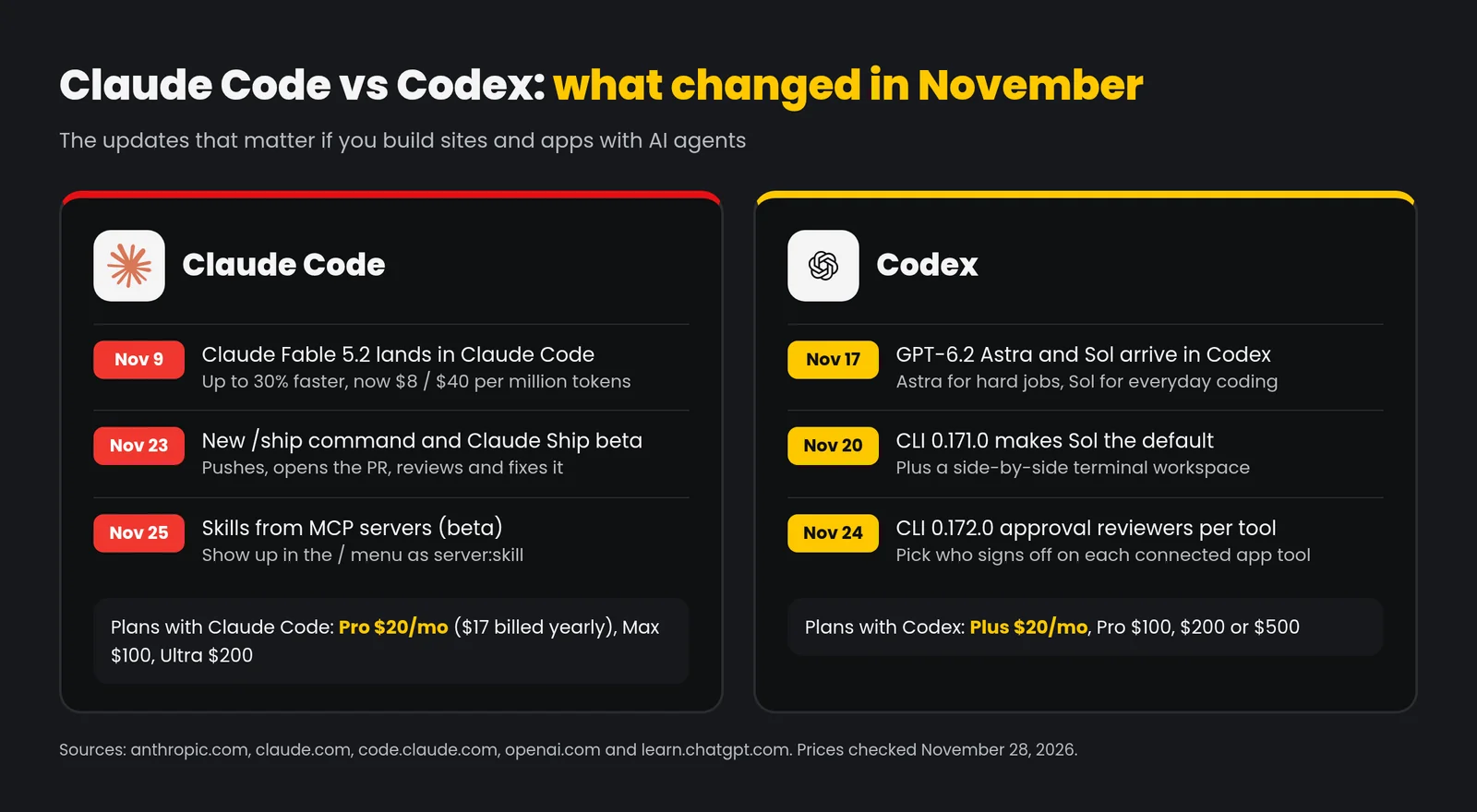
In other words, vibe coding means you describe what you want and let the agent write the code. That works great until the agent breaks something. Also, most of these updates are about control: who approves changes, which tools the agent can touch, and how to undo things.
What’s new in Claude Code
First, Claude Code is Anthropic’s coding agent. It runs in your terminal, in VS Code and in the Claude desktop app, and it comes with Claude Pro and up. Here’s what landed this month.
- Claude Fable 5.2 (November 9). Fable is Anthropic’s model for the biggest technical jobs, like a messy migration across a whole codebase. Anthropic says it’s up to 30% faster than Fable 5.1 and cheaper, at $8 per million input tokens and $40 per million output tokens. An optional fast mode runs up to 2.5 times faster for $16 and $80 (Anthropic).
- Who gets Fable. On Pro you pay for Fable with usage credits. Max and Ultra include it for up to half your weekly limit. For most coding, Anthropic itself recommends starting with Claude Opus 5.5 and only stepping up to Fable when a job needs it.
That last point matters for your wallet. Fable is the expensive model, so don’t point it at a contact form.

- Skills from MCP servers, beta (November 25). MCP is the standard way to plug an AI agent into outside tools. Since Claude Code 2.1.332, skills that come from a connected MCP server show up in the slash-command menu under the server’s name, next to your own skills (changelog). So when a service you connect ships its own how-to instructions, Claude Code can use them without you copying files around.
- Install artifacts as apps, beta (November 24). In the Claude apps, something Claude builds for you can now be installed as its own app on Mac or Windows, with its own window and icon. That’s handy for a quick internal tool, like an order tracker for your shop.
The ship command and Claude Ship
This is the big one for anyone shipping real code. When a change is ready, you run the ship command. Claude pushes it, opens the pull request, reviews the change, and then works on feedback and failing checks to get it ready to merge (Claude Ship announcement). What can actually merge still depends on your permissions and your repository’s branch rules.

The full Claude Ship setup has three parts: Code Review, PR Steward, which keeps the pull request green, and Claude Approvals, which approves routine changes based on a policy file you write. That setup is for Team and Enterprise plans on GitHub, and it’s billed on tokens, so it can add to your costs. Running the ship command on your own counts as normal Claude Code usage.
What’s new in Codex
Meanwhile, Codex is OpenAI’s coding agent. It runs in the Codex app, the CLI, an IDE extension and on the web, and it shares its usage limits with your ChatGPT plan. Here’s what changed.

- GPT-6.2 Astra and Sol (November 17). Astra is the heavy hitter for your hardest projects, like tracing a bug across services, fixing it and testing it. Sol is the everyday model for coding, writing and multistep work, and OpenAI says it lets you finish more tasks on the same paid plan than GPT-6.1 Sol (OpenAI). OpenAI also says Astra builds better-looking, better-working frontends, particularly for websites. That said, that’s OpenAI’s claim, not my test.
- API prices. GPT-6.2 Astra is $8 per million input tokens and $40 per million output tokens, the same as Claude Fable 5.2. GPT-6.2 Sol is $2 and $10. To use either one in the Codex CLI, you need version 0.166.0 or later.

- Codex CLI 0.171.0 (November 20). Sol is now the default model. The terminal workspace is on by default too, so document previews, image previews and subagent chats sit beside your main conversation (changelog).
- Codex CLI 0.172.0 (November 24). You can set an approval reviewer for each connected app tool in
config.toml, so a risky tool can need a sign-off while safe ones just run. Pressing Tab now completes slash command arguments, and optional MCP servers only start when a tool first needs them. - Codex app (November 17 update). You can fork a local chat, and in a Git project you can fork it into a new worktree. That lets you try a risky idea on the side without messing up the version that works.
Claude Code vs Codex side by side
Here’s how the two stack up after this month’s updates, using only what each company publishes.
| Claude Code | Codex | |
|---|---|---|
| Newest top model | Claude Fable 5.2 (November 9) | GPT-6.2 Astra and Sol (November 17) |
| Cheapest plan with the agent | Claude Pro, $20 a month ($17 a month billed yearly) | ChatGPT Plus, $20 a month |
| Free option | No Claude Code on Free | Free and Go get GPT-6 Luna in the desktop app, as it rolls out |
| Top personal plan | Ultra, $200 a month | Pro, $500 a month |
| Top model API price (input and output per million tokens) | $8 in, $40 out | $8 in, $40 out |
| New this month for pull requests | Ship command, plus Claude Ship on Team and Enterprise | Approval reviewers per connected tool |
| Publish a site or app | Install artifacts as desktop apps (beta) | ChatGPT Sites on Plus, Pro, Business and Enterprise |
Claude Code vs Codex pricing
Prices checked November 28, 2026 on Claude’s and ChatGPT’s official pricing pages, in US dollars, before tax.


| Plan | Price | What you get for coding |
|---|---|---|
| Claude Free | $0 | Chat only. No Claude Code. |
| Claude Pro | $20 a month, or $17 a month billed yearly ($200 up front) | Claude Code. Fable is paid with usage credits. |
| Claude Max | $100 a month | 5x Pro usage, Fable for up to half your weekly limit, $100 a month in API credits. |
| Claude Ultra | $200 a month | No 5-hour limit for verified accounts, 10x Pro weekly usage, $200 a month in API credits. |
| ChatGPT Free and Go | $0 or $8 a month | GPT-6 Luna in the Codex desktop app, subject to rollout. |
| ChatGPT Plus | $20 a month | Codex on web, CLI, IDE and iOS. OpenAI estimates 17 to 180 local GPT-6.2 Sol messages every five hours. |
| ChatGPT Pro | $100, $200 or $500 a month | No five-hour limit right now. Ultrafast with Sol on Pro $200, and with both models on Pro $500. |
So at the $20 level it’s a tie on price. The difference is in the details: Claude Pro makes you pay extra for Fable, while ChatGPT Plus gets GPT-6.2 Astra and Sol inside its normal limits.
What it means if you build sites with AI
If you run WordPress, the big trend is agents talking to your tools through MCP. Claude Code now picks up skills from MCP servers, and Codex lets you put a reviewer on each connected tool. If you want to see what that looks like on real hosting, my Hostinger Connector guide walks through managing hosting and WordPress with an AI agent.
If you just want a quick page for a launch or a small tool, ChatGPT Sites builds and hosts lightweight sites right from a Work or Codex chat. Building counts toward your Codex usage, and new Sites stay private until you share them.
And if you don’t want to touch code at all, honestly, skip both. Instead, an AI website builder will get you further, faster. I compare the best ones in my best AI website builders guide, and my list of the best AI plugins for WordPress covers adding AI to a site you already have.
Claude Code vs Codex: which one should you pick?
Pick Claude Code if
- You work in GitHub and want an agent that takes a pull request all the way to review.
- You want a top model for a big, gnarly migration and you’re on Max or Ultra.
- Your team is on Claude Team or Enterprise and wants approval policies.
Pick Codex if
- You already pay for ChatGPT Plus or Pro.
- You want to build, preview and publish a small site without setting up hosting.
- You want the newest models inside your normal plan limits.
Still new to all this? Learn the basics first with my guide on how to make a WordPress website. An agent is way more useful when you know what it’s building.
Claude Code vs Codex FAQ
Is Claude Code free?
No. Claude Code comes with Claude Pro ($20 a month, or $17 a month billed yearly), Max ($100) and Ultra ($200). However, the Claude Free plan doesn’t include it.
Is Codex free?
Partly. ChatGPT Free and Go get GPT-6 Luna in the Codex desktop app as it rolls out. The full Codex on web, CLI, IDE and iOS starts with ChatGPT Plus at $20 a month.
Which is cheaper, Claude Code or Codex?
In short, they tie at $20 a month for the entry plan. Claude is a bit cheaper if you pay yearly ($17 a month). The top models also cost the same over the API: $8 per million input tokens and $40 per million output tokens for both Claude Fable 5.2 and GPT-6.2 Astra.
Which Codex model should I use?
OpenAI says to use GPT-6.2 Sol for everyday coding and GPT-6.2 Astra for your hardest projects. Sol is now the default in the Codex CLI.
What is vibe coding?
Vibe coding is building software by describing what you want in plain English and letting an AI agent write the code. Claude Code and Codex are two of the most popular agents for it.
Closing thoughts
Here’s how I really feel, party people. This month was less about smarter models and more about trust. The ship command, approval policies and per-tool reviewers are all ways to let an agent do more without letting it wreck your project.
If you already pay for ChatGPT, start with Codex and GPT-6.2 Sol, because it costs you nothing extra. If you live in GitHub and hate babysitting pull requests, Claude Code with the ship command is the upgrade worth paying for.

Want a no-code alternative instead? Check out my AI website builder picks, or build a WordPress website yourself like I do.

About the author
Darrel Wilson
Darrel Wilson is a certified web hosting expert with more than 10 years of experience, an AI expert with more than 5 years of experience, a developer who understands AI, and a full-time content creator on YouTube covering these topics.
Disclosure: This post has no affiliate links. Neither Anthropic nor OpenAI paid for it, and prices and claims come from each company’s own pages.
Darrel Wilson
Web hosting and AI tools nerd, full-time YouTuber, and your guide to the party.
Keep reading
Latest release notes

Claude Code
Claude Pro: $20 a month, or $17 billed yearly. Checked November 28, 2026.

Codex
ChatGPT Plus: $20 a month. Checked November 28, 2026.
No affiliate links. These go to each company’s own release notes.